

Sight and Time
Thoughts after seeing Andrea Bocelli for the first time in concert.

I remember, in college, blasting Romanza, Italian tenor Andrea Bocelli’s best-selling album, from the third floor room in the freshman dormitory where I both worked and lived.
It was spring, my favorite time on campus, and I had pushed up the old windows, so the fresh air—laced with the fruity reek of Bradford pear trees—could sweep in, fluttering the fringes of the red silk shawl I had tacked up as a curtain.
That afternoon, Andrea Bocelli’s voice became synonymous with youthful optimism to the point I still cannot hear “Time to Say Goodbye” without wanting to fling up some windows.
On Monday, my husband and I went to Nashville to hear the sixty-seven-year-old Italian tenor for the first time. (I should clarify: I went to hear him for the first time; my husband went because he loves me.)
In between songs, I could hear Bocelli clearing his throat and even subtly coughing. It wasn’t that this detracted from his powerful voice; he had always just been larger than life to me, mythical in his proportions, and I was now acutely aware of his humanity and, therefore, his vulnerability.
He had grown older in the past twenty years, the same as I. His hair had faded from black to gray. He even looked thinner. When the beautifully garbed women would escort him to and from the stage—for he had been blind since childhood—I watched his steps as though he was my father; my body tense, my mind pleading, Please don’t fall.
During intermission, my husband said, “Think of the fact that, as a blind person, you cannot see yourself aging. You can only go by how you feel.”
I contemplated this in the second half of Bocelli’s performance. He rose to fame when he was thirty-five years old, so for thirty-two years he has continued to tour, sing, and impact the world with the emotional purity of his voice.
Of course, I don’t know Bocelli personally, and yet from what I have read about his extensive humanitarian efforts and penchant for rescuing stray, injured dogs from war zones, he seems like a good man; perhaps even the “Theo of Golden” of our generation, who possesses a clarion perception the rest of us lack.
With the advent of Facebook in 2004 (when I was a freshman in college) and all the social media that has spawned from its dubious theory of connectivity, our world has been reduced to a highly visual state. We post stories, reels, and pictures, then wait for the feedback loop of comments, shares, and likes.
The beauty industry, of course, rides on the coattails of this visibility. A term called “selfie dysmorphia” is on the rise as young women (many whose faces and bodies are still developing) try to physically match the filters found on their social media pages and then feel inadequate when they do not.
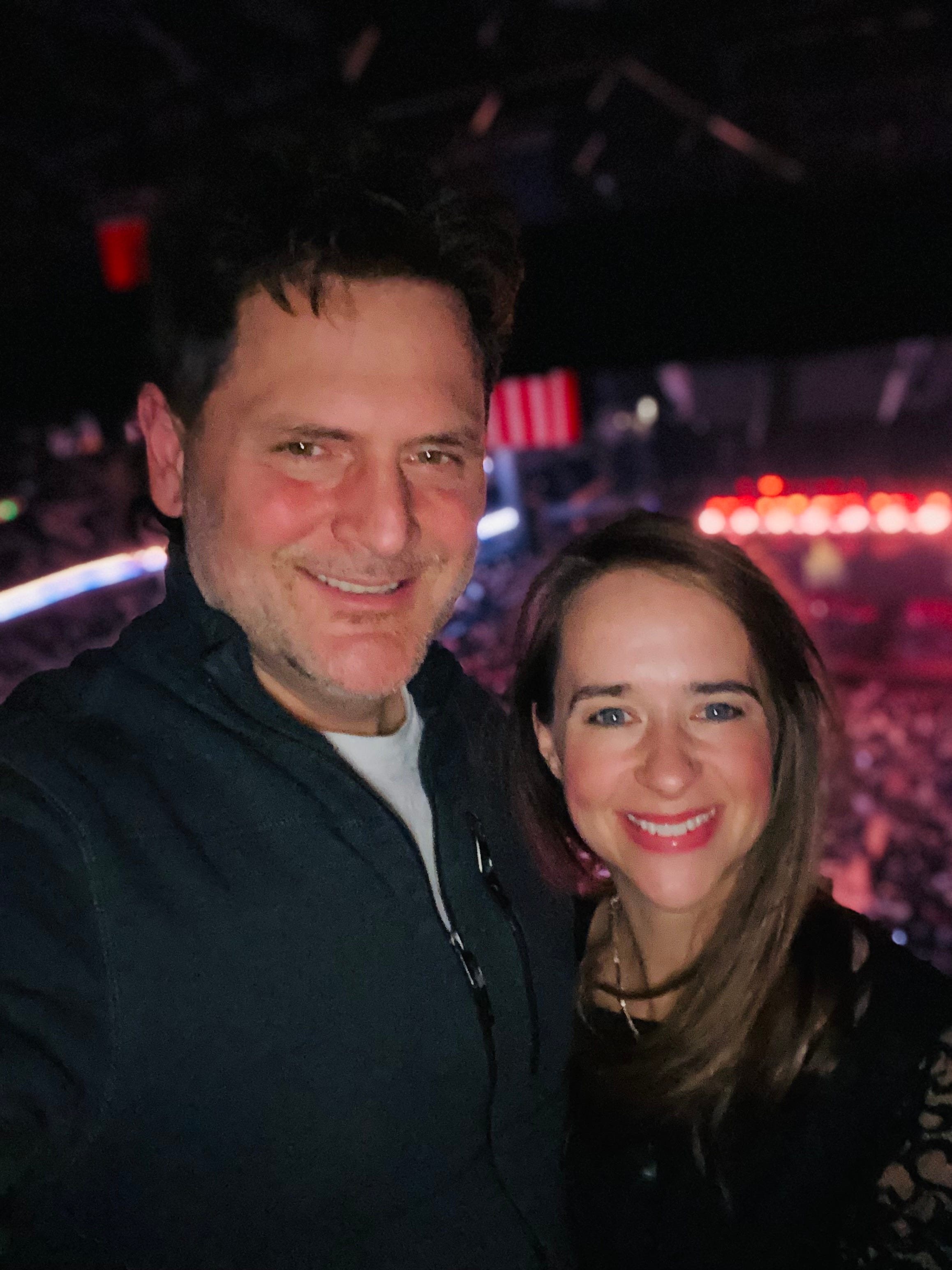
However, after my husband and I took a selfie together at the Andrea Bocelli concert, I scrolled through my own social media filters to see if one would make us look like we weren’t tired parents of four who were unaccustomed to being out on the town at 9 p.m.
Last night, my husband was helping our daughter with math in the kitchen when he noticed he was having difficulty seeing the numbers. He sighed and went into the office and then returned to the table.
I glanced over and saw he was wearing the cheap pair of reading glasses (the prescription sticker still stuck to the right lens) that his younger brother had mailed to him as a joke.
“How did my vision go so fast?” he asked, peering up at me through the too-small frames. “Will it only get worse?”
I worked hard not to laugh. I have worn contacts or glasses since I was seventeen and realized, while driving, that I couldn’t see the exit numbers until I was right up on them.
So, though I could commiserate with my husband, I also found it slightly humorous that, at forty-six years old, he no longer had the eagle eyes he had sometimes taken for granted.
Ten days ago, my best friend texted a picture of her holding the novel, Hamnet, that I had mailed to her.
For the first time in thirty-seven staggering years of friendship, I saw that she was wearing round, gold spectacles.
She replied to my observation, “I am officially in the reading glasses club for old folks. No shame in my game.”
Both my husband and my best friend should not be experiencing the bittersweet privilege of growing older.
I almost lost him to a rare, benign brain tumor when he was thirty-five years old. My best friend, a three-time cancer survivor, was given no hope in October 2024.
And yet there my husband was, wearing cheap reading glasses at the kitchen table while helping our daughter do math. There my best friend was, wearing reading glasses on the couch while snapping a selfie.
Walking so closely to death helps us see what really matters.
My stomach dropped on Monday night when Andrea Bocelli thanked everyone for coming. I looked over at my husband in disbelief. “He’s really not going to sing ‘Time to Say Goodbye’?”
But then Bocelli returned for an encore performance after the audience (myself included) clapped and begged for more.
My eyes filled with tears as the familiar notes swelled across the darkened arena, and then he began to sing the ballad I had blasted from my third floor dormitory room twenty-some years ago.
I had packed a handkerchief in my coat pocket because it was so cold outside, which makes my eyes and nose run, but now I brought it up to my face as I wept.
How does a human voice touch my soul—our souls—to such an extent? Most of the words to “Time to Say Goodbye” and “Vivo per lei” I couldn’t even interpret, but my heart could interpret their meaning just the same.
I was working on this post this morning when I encountered a friend at the coffee shop whose daughter had been at the same concert. She, who is very musical, said that someone who is blind has more enhanced auditory abilities (think: Ray Charles, Stevie Wonder, and of course, Andrea Bocelli).
Has Bocelli’s blindness, a congenital defect his mother’s doctors had advised as reason enough to terminate her pregnancy, merely served to accentuate his gift?
He is able to focus on the unseen rather than the seen and therefore can tap into a realm that is not always accessible to those of us with normal sight.
This year, and for the rest of my life, I want to focus on what truly matters.
I want to take time to hear my children’s questions, to touch their faces and hands, to hold my husband with the tender awareness that our love started when we were both flushed with youth, and if time is kind, we will continue to hold each other as our hair turns gray and our bodies grow weaker.
But grace is found in the fact that, if carefully cultivated, our souls can grow stronger and more beautiful within that same span of time.
It’s all about our perception.
Well, this was beautiful. I love hearing (or reading) your thoughts as you process life. “Walking so closely to death helps us see what really matters.” Isn’t that the truth. ❤️